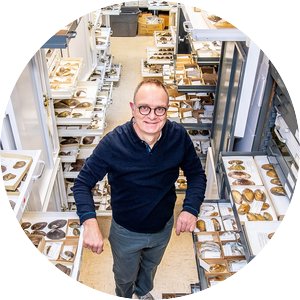
Andrew M. SimonsAndrew M. Simons

Associate Professor, Department of Fisheries, Wildlife, and Conservation Biology
Curator of Fishes, Amphibians, and Reptiles, Bell Museum of Natural History
E-mail: asimons@umn.edu
Ph.D. The University of Alabama, Tuscaloosa

Fields of Interest

North American freshwater fish systematics, theory and practice of phylogenetic systematics using morphological and molecular data, evolution of complex morphological character systems

Fish Collection: www.bellmuseum.org/fish.html
Amphibian and Reptile Collection: www.bellmuseum.org/herps.html

Courses

  • FW 3136/5136 Biology of Fishes

Research

My research focuses on reconstructing phylogenetic relationships of North American fishes. A phylogenetic hypothesis provides a historical framework for investigating hypotheses of speciation and adaptation and has proven to be critical in many evolutionary studies. I am particularly interested in relationships of minnows and carps (family Cyprinidae), one of the largest families of fishes. These fishes are very diverse and occur in a wide range of freshwater environments, from hot springs to large rivers. Much of my work has utilized mitochondrial DNA sequences to recover the pattern of relationships among North American cyprinid genera. I am also interested in using phylogeographic techniques to understand speciation and dispersal of Central Highlands fishes. Future research involves integrating mitochondrial sequences with nuclear sequences and morphological characters, using these data to explore the evolution of morphology, behavior, and biogeography of these fishes. I am particularly interested in utilizing phylogenies to investigate the evolution of complex trophic morphological characters and historical constraints that act on trophic shifts in fishes.

Selected Publications

  • Berendzen, P.B., A.M. Simons, and R.M. Wood, T.E. Dowling, C.L. Secor. 2008. Recovering cryptic diversity and ancient drainage patterns in eastern North America: Historical biogeography of the Notropis rubellus species group (Teleostei: Cypriniformes). Molecular Phylogenetics and Evolution (46): 721-737.
  • Gamble, T., A.M. Simons, G.R. Colli, L.J. Vitt. 2008. Tertiary climate change and the diversification fo the Amazonian gecko genus Gonatodes (Sphaerodactylidae, Squamata). Molecular Phylogenetics and Evolution 46: 269-277.
  • Egge, J.J.D. and A. M. Simons. 2006. The challenge of truly cryptic diversity: diagnosis and description of a new madtom catfish (Ictaluridae: Noturus). Zoologica Scripta 35:581-595.
  • Mayden, R. L., A. M. Simons, R. M. Wood, P. M. Harris, and B. R. Kuhajda. 2006. Molecular Systematics and classification of North American Notropin shiners and minnows (Cypriniformes: Cyprinidae), p. 72-101. In: Ma. De Lourdes Lozano-Vilano and Armando J. Contreras-Balderas (Eds.). Studies of North American Desert Fishes in Honor of E. P. (Phil) Pister, Conservationist. Universidad Autonoma de Nuevo Leon, Mexico.
  • Ray, J. M., R. M. Wood, and A. M. Simons. 2006. Phylogeography and post-glacial colonization patterns of the rainbow darter, Etheostoma caeruleum (Teleostei: Percidae). Journal of Biogeography. 33:1550-1558.
  • Gamble, T., and A. M. Simons. 2004. Comparison of harvested and nonharvested painted turtle populations. Wildlife Society Bulletin 32(4): 1269-1277.
  • Ghedotti, M. J., A. M. Simons, M. P. Davis. 2004. Morphology and phylogeny of the studfish clade, subgenus Xenisma (Teleostei: Cyprinodontiformes). Copeia 2004:532-61.
  • Simons, A. M. 2004. Phylogenetic relationships of the genus Erimystax (Actinopterygii: Cyprinidae) based on the cytochrome b gene. Copeia 2004:351-356.